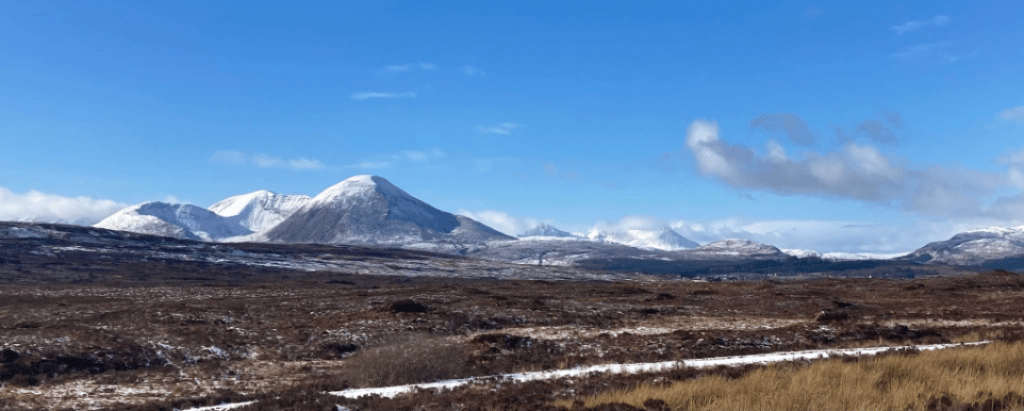
Being na Caillich

We had lunch in Broadford. Snow smacked wetly on the windows, and people came inside to get away from it. Out beyond the bar and the shining coffee machines, I watched Beinn na Caillich vanish into the blizzard. Nobody looked up or mentioned the mountain, even when it came out steaming in the sunshine afterwards.

It’s said that a Viking princess was buried on the summit of Beinn na Caillich. The cairn they built around her body is so large that you can see it for miles, and everything here is coloured by those connections. I’m used to thinking of wonderfully carved ships picking routes up the Trent or the Thames to frighten the Saxons, but here are the Lords of the Isles; an entire Viking nation on the edge of the Atlantic Ocean. It’s hard to know if those raids on the south and east of England were more relevant or striking than these western hosts, or whether we’re led to think of them more because everything is brighter or bigger in England.

Everybody’s heard of Guthrum and the Great Summer Army. It’s part of the national story because it relates to King Alfred and the English Kings. But I know that Vikings stayed two winters on Lough Neagh. I could feel those men as I paddled there last summer, listening to the offspring of great crested grebes. And I could feel them againin the slightest flake of silver on display in the museum at Whithorn, labelled Hiberno-Norse penny, struck in Dublin in 1025AD. Western Vikings chime more deeply with me than English stories about Jorvik and horned helmets at the battle of Stamford Bridge.

I have been reaching for a way to think of the Irish Sea, the North Channel and the Western Isles as one contiguous mesh of land and water. It has helped me turn the map on its side and translate West into North. That reveals how all the lanes can fit together, but the better lesson is to find yourself suddenly disoriented by rotation, looking afresh at shapes which can be too familiar. Lie Skye on its side and look at the opportunities which arise. It’s not in the top left-hand corner of the map, but somewhere just right of centre. That simple twist helps to understand how the Norse-Gaelic Lord Somerled marshalled resources from the Western Isles and Ireland and to force an invasion of Scotland in 1164; a mind-boggling rejection of modern north/south nationalities. These themes are reflected in Heaney’s North, which is shot-through with Norsemen. But Heaney’s North is also shot-through with violence and reverberation; patterns of movement and recurrence from the ancient days to modern vignettes of the Troubles. 

Some Northern writers are fixated on the word “remote”. Their work strives to remind us that “remoteness” is relative to arbitrarily chosen “centres”. There is no inherent reason why the south should be nearby and the north far-flung, and there’s mileage in exploring this. The Lords of the Isles offer a counter-argument to simple Southern myths of Saxon Christians and Norse Pagans. We’d do well to turn the maps and orient ourselves accordingly.


Leave a comment

About


“‘A privacy of glorious light is thine; Whence thou dost pour upon the world a flood Of harmony, with instinct more divine; Type of the wise who soar but never roam; true to the kindred points of heaven and home”.

Newsletter