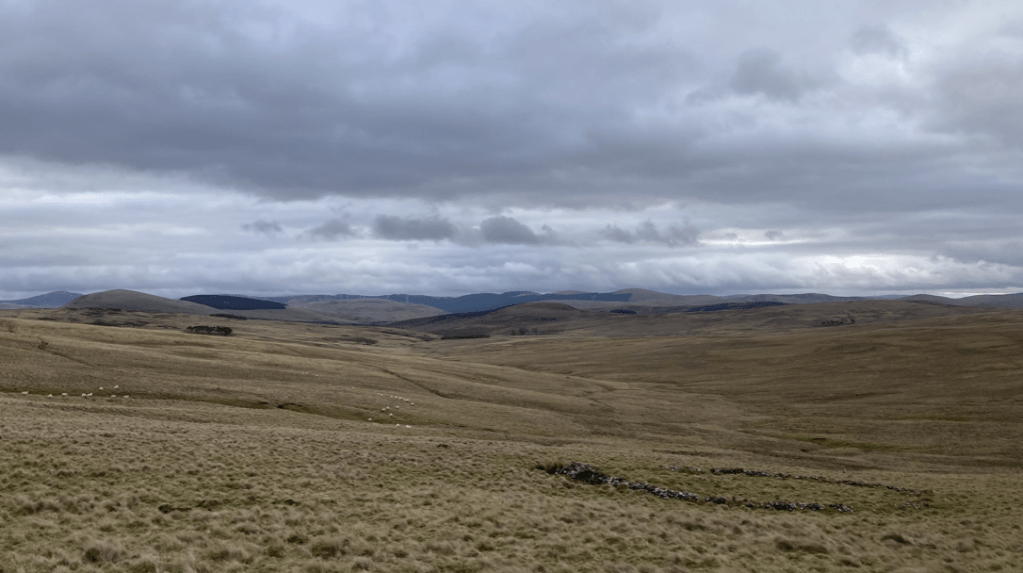
The first bird I saw sat tightly, then flushed like a grouse from the grass. I might’ve taken it for a grouse, but only because I find golden plover so unusual. I’m not ready to accept them as an option, and they don’t come come easily to hand on the spur of a moment. But it was never a grouse, even before the soft and failing sound of its call came to prove it. And when it landed after one hundred yards, the plover held its wings open for several seconds to settle. That means something; it’s a signal of some kind, but it’s lost on me.
Lanarkshire trailed away behind the standing bird; the hills towards Biggar and Moffat in a steadily receding stack of torn edges. Then it was gone and calling again, with a flash of its belly above fallen fanks and the shapes of sheep in the endless space. Golden plover have white bellies, but it came up grey like a wink of wet snow in the overcast day.
I was ready for more plover when I found them; periscopic heads on a short horizon and miles of Clydesdale beyond. Gripping my binoculars, I watched an individual blink at the range of fifty yards. Rather than rise into the wind, they had chosen to run ahead of us like rabbits. Why fly when it’s cheaper to walk and hide on these hills? But I know they’re built for speed and long distance, and this pragmatism struck me as tight-fisted. I only wanted to watch them go; if I could fly, I’d do it all the time. Heads bobbed and the birds walked gently away between mounds of redly trampled moss.
Seeing they had chosen not to fly, it would have been unfair to press them up by force. I told myself that I was the bigger man for not disturbing them, but the decision was always theirs. They moved off, but then with a rush of swarming wings two dozen more came up in flight from behind and above them, churning over the nodding grass. I was not to blame for that disturbance. I can’t say what caused them to rise in panic, and I could only stare in delight and amazement as they came towards me at head-height. They didn’t see me until the last moment, then panicked and with an enduring downswept call, they turned away and threw new space behind them. I watched them gaining height above the ruins of an abandoned chapel half a mile away. They jinked on crisply pre-determined turns, then out again for the sake of height and emptiness.
Forty miles northwest and behind those birds, a low sun tore through clouds onto Glasgow. Blocks of flats and factory walls shone to show how all the human beings have washed out of these hills to settle like sediment in the city. The only homes are ruins here, and all the dykes can do is compliment the scale of mile upon mile to the far horizon. The birds rose sharply and rushed away, falling through configurations of lines and gangs and once a trembling chevron. With only distance to conceal them, I lost them at last as they moved towards Ayrshire and the Firth of Clyde.
You could reasonably argue that when winter comes to Lanarkshire, these hills are golden plover country. Nothing else is left, but if these birds are unfamiliar to me, that’s hardly because they’re scarce. I like to think they fill the spaces people never go.

 Heaven and Home
Leave a comment