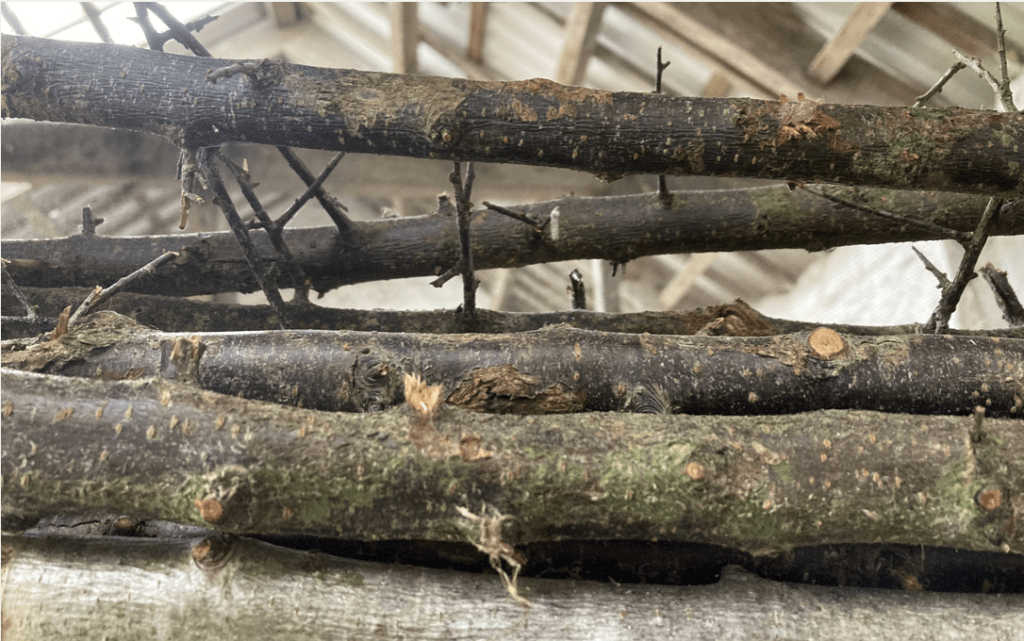
I cut a blackthorn hedge at Hogmanay. I did it by hand with a flexible saw, and I saved most of the wood for kindling. As I threw sticks into a wheelbarrow, they landed upon other sticks, and the chattering pile played a cheery little tune in the frost. Even by lunchtime, the cuts were oxidising. The white circular ends glowed up to a citric orange.
Now and then, I’d find a length of stem which grew three or four feet long in a reasonable expression of straightness. I saved these, knowing that blackthorn shanks make excellent walking sticks. I carried them home and hung them in a bundle in the rafters of the workshop to dry. They vanished there, but were rediscovered last week as I bumped them with a ladder and set them swinging. That’s how I remembered them, and why I cut them down.
I’d hoped to make nice crooks from these blackthorn shanks. I took them to the class in the town, and the instructor told me I should have dabbed each end in paint to stop them splitting. He showed me how the sticks have cracked, and all but two are almost wasted. I’ll take extra care of those two now, and thought how the cost of a good lesson is always something lost.
I couldn’t bear to waste those cracked-up shanks. They might be split, but I can use them for rougher work, so I took one and began to clean it up. I sawed off the thorns and filed them down into knuckles. When that was done, I sanded the stumps so that now if you were to touch thumb and forefinger together, that shank would drop through the hole like a slip of silk. As I worked, the shank itself seemed to brighten. One end became a rich and marbled chocolate brown. As your eye glides to the far end, that chocolate’s flourished into a wondrous red and the polka-dot pattern of sawn-off bumps. It’s so beautiful that I can hardly take my eyes off it.
When you think of all the work required to make sticks for shows and displays; all the fuss of varnish and steam to make something shiny and smart – take that work and measure that against the simple joy of a roughly handled blackthorn shank. It’s a close-run thing, but I must confess I actually prefer the unworked object. I didn’t see that coming, but I’m ever more fixated on the smallest, purest unit of things; the appleseed behind the cider, and a sense that we all should do half as much and twice as well. So when I brought my cattle off the hill this weekend, they walked a quarter mile to their pens and I drove them before me with that simple blackthorn stick in my hand as if it were a wand.
You mustn’t strike a cow, but touching’s quietly potent. You can steer and advise them with a good stick, and the shock of a prod is enlivening, even when it’s gentle. Greater still is the sense of widening that only a stick can provide. Even a child can fill a gateway with a stick in each hand, and the illusion of a blockage is surprisingly powerful. If nothing else, it shows a beast what you’re trying to do, even if it later disagrees. So I turned that stick to work, carrying it with a sense of pride at having not only found the right tool for the job, but also an object of wonder in itself.
The cows are home because the hill grass failed them. The moors turned red for the season’s change, and the hills in autumn remind me of Robert Louis Stevenson’s poem To SR Crockett, in which he writes of our “vacant, wine-red moors”. He’s writing to Galloway, and it’s a desperately beautiful poem – but “wine-red” has often bothered me. I agree that while autumn’s red consumes the summer’s green in the south west, it’s more like the red of rust and stags. Wine-red’s too rich and fleshy, and besides, wine is no drink for moorland places. The metaphor’s a clash, but Stevenson was never clumsy.
Driving beasts downhill and threading the words of To SR Crockett back and forth through my fingers, I suddenly wondered if wine-red is something more than literal. Maybe it’s a suggestion towards “wine-dark”, (oînops póntos) the Homeric epithet used in both Odyssey and Iliad to describe the sea in a coming storm. Perhaps Stevenson is couching Galloway in mythological terms, accessing a store of associations to the deep, disturbing mystery of an ancient sea.
The brooding wine-darkness of Homer’s Aegean is both a gateway and a crucible where tiny humans endure the acts of uninterested gods in prayerful humility. That chimes with Stevenson’s broader context in To SR Crockett, and it serves to magnify the enormity of his other images he uses to express something of Galloway; the standing stones, the calling birds and the flying rain; things at once both concrete and ethereal. It’s a descriptive masterclass, but that simple twist of association goes further and sheds light upon my ever-shrinking focus upon the small and the dowdy.
The Galloway of To SR Crockett pretends to conjure an illusion of emptiness, but any sense of abandonment is really just an interval between two periods of activity; between an ancient busyness and the rising awareness of approaching death. Nothing can exist in this all-too-turbulent space without history or future, inheritance or bequest. In the epic tapestry of Stevenson’s wine-red moors, everything is ready and relevant. Even the smallest objects posess sufficient power to cast a charm. So it’s no surprise that I should find myself besotted by an unworked blackthorn stick. The only unexpected thing is that I am able to bear its weight.

 Heaven and Home
Leave a comment